
Interference

A couple of weeks ago, when New Hampshire’s governor had finally mandated masks wherever people could not stay at least six feet from each other, we went for a hike. We were out early, but by the latter half of our walk, the trails had grown crowded. Roving bands of up to ten unmasked people traipsed by us, and though our family did wear masks, we were forced off trail each time, avoidant, standing facing into the woods until the threat had passed. The trails here are narrow, and generally hemmed in by trees, so six feet of distance was never possible while also staying on the path. This meant choosing either to be too close to unmasked people, or to break the covenant all trailwrights make with the woods: we humans will carve this wound through you, but we will damage only this, and though we will, admittedly, wear this line down to the bedrock, we will not trammel the embankments nor molest the mosses alongside. This means, for instance, trekking directly through mudholes, if the trail goes there, rather than diverting around them and eroding the verges. This is the principle anyway, but trails draw a lot of people who don’t know this and, through their ignorance, or fussiness about mud, bring about incremental destruction to a widening swath, bootfall by bootfall. By the end of the hike, we were edgy and irritable, tired of worrying about a bunch of people who were so obviously not worried about us. I hissed at the preponderance of Massachusetts and New Jersey plates on the cars in the parking lot.
The next day, I opted for a run on the lesser used forest roads behind our place. Locals mostly walk there, and vehicle traffic is prohibited, though the ways are broad enough to accommodate them. I figured this would make it easier to give anyone I passed the requisite wide berth, even if they weren’t wearing masks. A quarter mile from the house, I saw a woman up ahead with dogs. I didn’t like the look of the situation. The dogs were leashed, but I could see she was struggling to haul them all in to heel, but she was all the way on one side of the dirt path, and I would have at least seven feet of clearance if I skirted the other side. I stopped running just the same, not wanting to trigger any of the dogs’ predatory drives. Then my memory goes blank for a brief time. I remember the woman still up ahead, knee-length down coat, gray-streaked hair pulled up in a bun, the dogs, at my approach, growing increasingly agitated, all pulling in my direction. One was a pale Labrador, head raised at my approach. Two others were squirming and strained on their leads in a brown blur—maybe a golden retriever, and another one I processed not at all. They seemed a single being, a many-mouthed, suburban Cerberus. I don’t remember anything about approaching them, or what I thought as I got close. The next thing I remember is the woman saying, “They’re friendly, they’re friendly,” as they dragged her all the way across the road to me and I was half way up the embankment beside the road, trying to squeeze between the dogs and a line of pines that had me hemmed in, not looking at them, only searching for a clear way through. I felt a sharp pain in my calf and figured I must have driven it into a broken branch as I pushed through the undergrowth, until I heard her say, “Did he bite you?” and then I realized what the pain was and in a high, thin tone of disbelief, said, “Yeah,” and then I squirted through the narrow slot between dogs and trees and I bolted. I sprinted until I’d put several hundred yards and a couple bends in the road between us and I could no longer hear her calling after me, “I’m sorry! I’m so sorry!” and then I stopped to pull up my running tights and inspect my leg, which was bleeding and purpled. I didn’t think long about abandoning my planned eight mile run, maybe because the only way back home was the way I’d come, back past them, so I rolled my pant leg back down and kept running into the woods, fast, ragged-breathed, my calf aching and throbbing intermittently, my mind aware that I seemed strangely untroubled by the attack, aware of itself like a parent watching a wired child up past bedtime proclaim that she’s Not Tired At All, knowing she’ll drop in her tracks soon, be asleep on the floor where she falls.
It was in this strange grace, this freefall, another two miles along, that I came upon a man up ahead on the forest road. It was a straight section, so I could see him from a long way off. He was dressed for running, but was standing in the middle of the road, and he looked at me, watching me approach for several seconds. Then he stepped to the side of the road, though not off it, and seemed to be looking into the woods. I thought maybe he had seen some kind of animal, and I looked in that direction too as I got closer. As I passed him, I saw his hand jostle at this groin. I kept running, figuring he’d been shaking off urine, and dimly considered why that didn’t seem quite right. Another quarter mile and I realized he’d seen me coming, I had not surprised him, so whatever he did, he did knowing a solitary woman was going to witness him. Another quarter mile and it occurred to me that he had not stepped off the road even by a few feet, or tried to even arrange a tree between us. If he’d been urinating, he’d chosen to do so in the road, as a solitary woman ran past him. Another quarter mile, and I understood that urinary urgency would not explain why he waited for me to approach, remaining on the road, until I was close enough to see his hand at his crotch, but could not wait another ten seconds for me to pass. He had chosen for me to see that ambiguous motion of his hand. He had known I was alone, three miles from the closest trailhead. My leg aching, half way up another steep, I stopped then, and tilted my head back, and howled.
I had to turn around eventually, and on the return leg of my run, I encountered him again, running fast toward me. He met my eye and nodded and gave a small wave. My chest seized and I held my breath as I passed and clung to the edge of the road near a ditch and I nodded back at him, and what I cannot remember now but what is possible is that I might have smiled at him.
What do we owe each other? What distance, how much space? Six feet is farther than you think. Stores place decals on the floor now for when you’re waiting in line because people naturally get closer than that, even to strangers. Six feet is too far away to touch someone even if both of you have your arms outstretched. Closer than that, even masked, and your circles overlap in a Venn diagram. Your nimbus of invisible particles, aerosols, sloughed skin cells and dust mites interferes with theirs.
In biology, there is an idea called the extended phenotype, where the ways an organism modifies its environment are, in a way of thinking, part of that organism. The meadow and the drowned trees standing where a beaver dam has flooded a forest are part of the beaver. The bowerbird’s elaborate sculpture is an extension of the bowerbird himself. In philosophy, the extended mind theory says something like that about human cognition—that the mind does not reside entirely within the skull, that the mind and its environment are a coupled system at least, that the surroundings are the mind’s annex; the interface is porous.
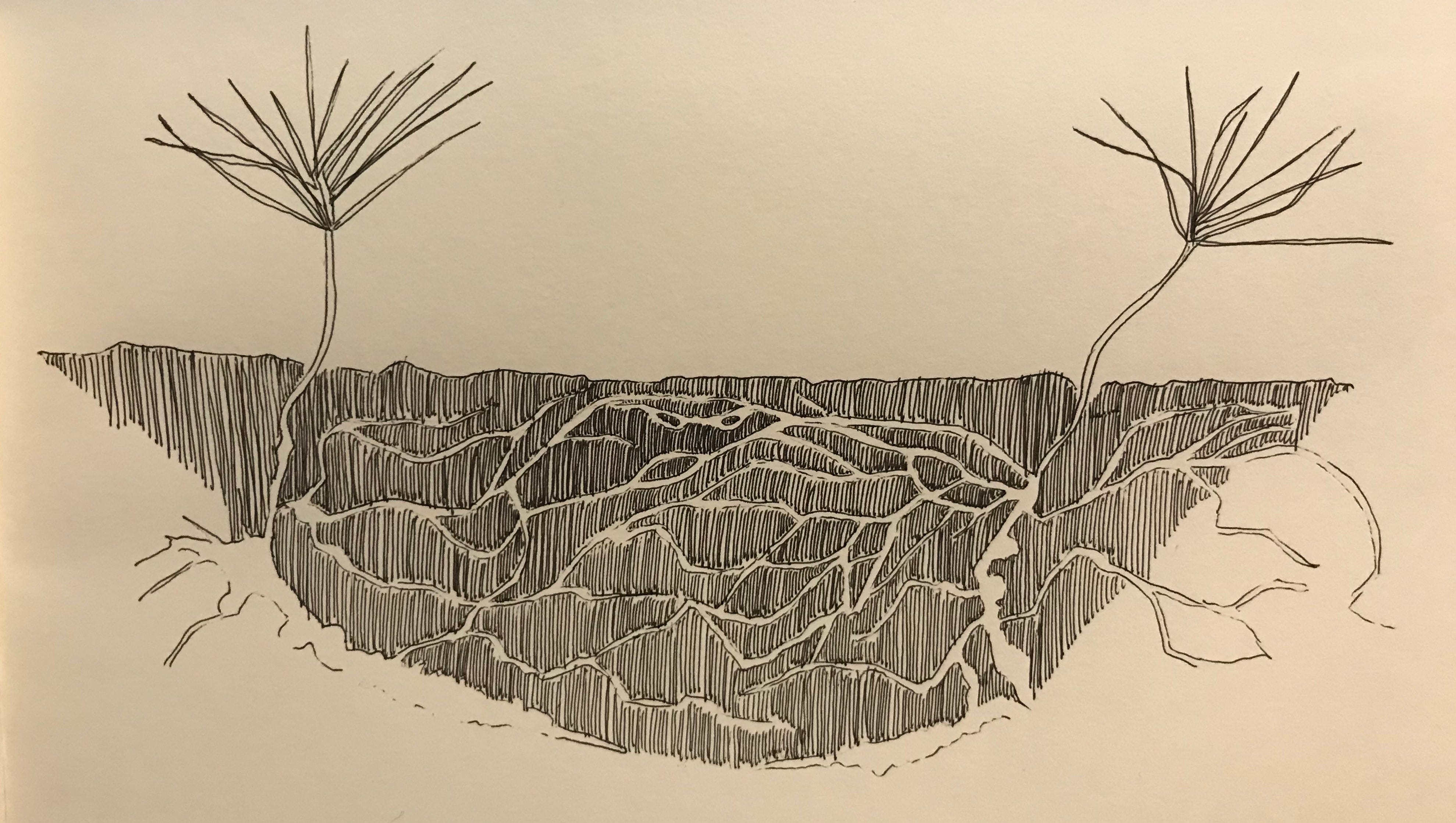
The strain of American thought that fixates on liberty, on freedoms of a certain sort, has run up hard against the pandemic reality of this porousness between our individual bodies. Our libertarian streak posits that, as long as an individual’s choice doesn’t harm anyone else, it should not be infringed or impinged. It sounds tidy. It reminds me of the photographs of tree canopies that illustrate the concept of “crown shyness” where the leaves of one tree will not touch those of its neighbor, and a neat channel of uniform width forms between them. Why this happens is not entirely clear; it may be a moat to prevent damaging insects from invading via a neighbor, or it may be to avoid growing wasteful leaves where they would only be shaded by the neighbor’s leaves, or it may be that leaves from both neighbors do grow into those spaces, but they get damaged by colliding and abrading each other in the wind and drop to the ground. Regardless of the why, what seems at first like a natural allegory of keeping to one’s self, of non-interference, and of living and let living turns out to be belied by what’s going in in the subterranean darkness. There, it becomes hard to tell where one tree ends and another begins—where not just the property line lies between neighbors, but even where the limits of a tree’s body are. The roots branch and attenuate, and then, at the tips of the smallest roots, what appear to be even smaller roots turn out to be fungal filaments, bridging the gap between one tree and the next, fluxing nutrients between tree bodies, communicating, passing water and sugars in one direction or the other, leading some scientists to ponder whether the organism might not be an individual tree at all, but a community of them, or even a whole forest of different tree species. What is the fundamental unit of biology in that case? Discrete alleles of individual genes? A cell? A tree? A woods?
The unmasked woman, the dogs, her breathing hard near my ear as she wrestled with them, I entered their space, or they entered mine. The bite destroyed some of my cells, separated some others from their neighbors. My body knew this, and commenced repairs. The bruise spread and changed color. The long drag marks of the canine teeth, and the lined up punctures of the incisors left a glyph in my skin. Over the days it became red-rimmed, glowing like a brand. In the places where the cells could not bridge the gap directly, there will be a scar laid down. The woman thought her dogs were friendly, I suppose because they had never bitten her. The unmasked people thought it was alright, I suppose because they thought they didn’t have the virus, or because they thought no one did, because it didn’t exist, or because they thought three feet felt like six. “They’re friendly,” “I’m being safe,” “I think it’s fine,” — these comforting phrases that have been drained of comfort, because those uttering them are not uttering them from a careful assessment of risk. They come instead from wishes, from fatigue, from longing for a world that is other than it is. So we make promises to strangers that we cannot keep. We incur debts we cannot repay. We make incursions, acting in good faith or bad, though intention, in truth, doesn’t matter much. If “friendly” can mean anything, including bruises and blood, then it means nothing at all. We are faithless in our vows to each other. The bite wound itches as it heals.